FRG-01Steel and forging
Pattern welding, and why the pattern appears
Pattern welding is a way of building a blade out of many small pieces of unreliable metal, which is exactly the problem a bloomery furnace hands its smith. The pattern is a side effect that became a selling point.
Published on 29/07/2026, last reviewed on 20/08/2026
What pattern welding is
Pattern welding is the forge welding of several rods of different iron and steel into one billet, which is then twisted, drawn out and ground so that the boundaries between the rods show on the surface as a pattern. It is a construction method, not an alloy and not a heat treatment.
The sequence, as far as excavated blades and modern reconstruction agree, runs like this: rods of roughly 5 to 10 mm section are stacked and welded at a yellow heat under a flux, the welded bar is twisted, several twisted bars are welded side by side to make the core, edges of higher carbon steel are welded on, and the whole is drawn out, straightened, ground and finally etched.
Why the pattern appears
The pattern is a chemical difference made visible. Iron with a significant phosphorus content resists acid attack and stays pale; low phosphorus iron and carbon steel darken. Etch the ground surface, and the alternating layers of the twisted rods appear as chevrons, herringbones or rows of interlocking bands depending on how the rods were twisted and how deeply the surface was ground.
Metallographic sections published since the 1970s tie the pale bands to phosphorus rich iron and the dark bands to low phosphorus iron or steel. This is also why patterns sometimes emerge on excavated blades as they corrode: corrosion is a slow, uneven etch.
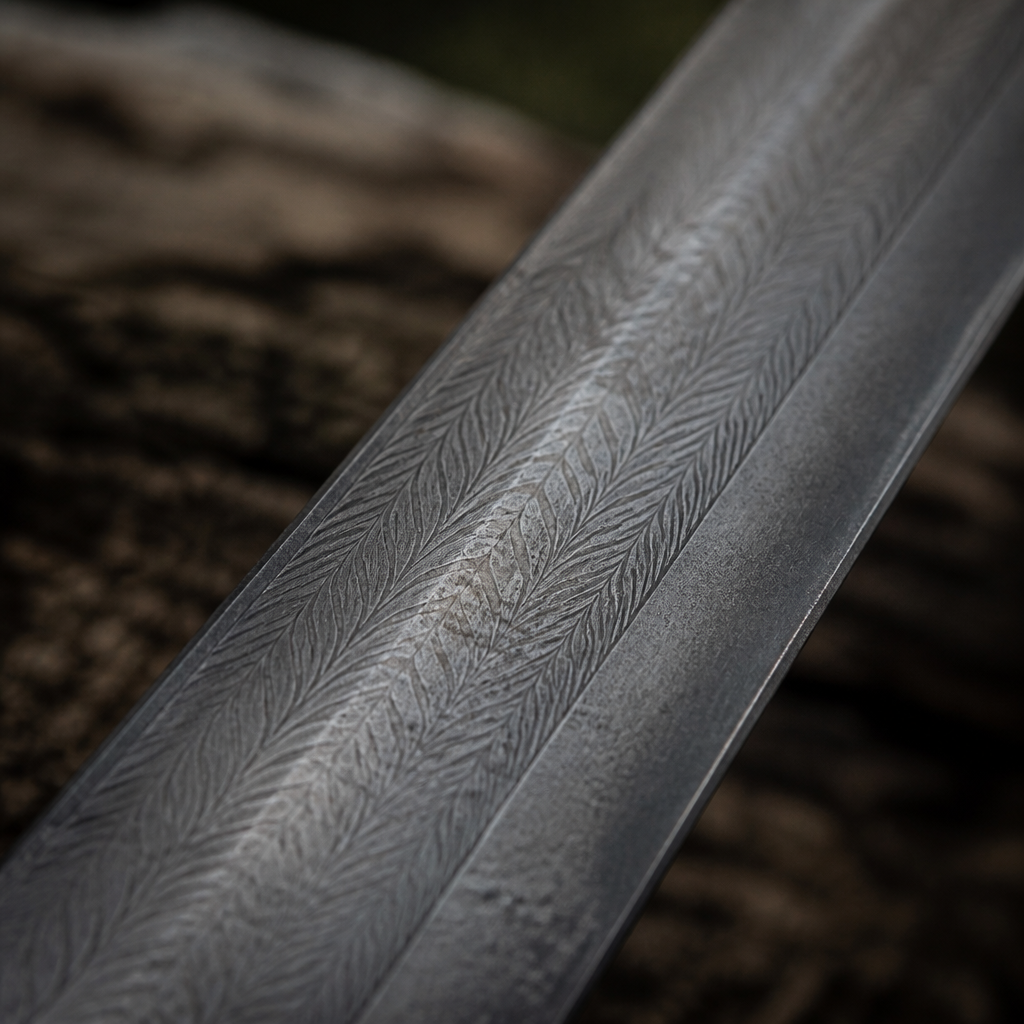
How a composite blade was assembled
A typical Migration period or early medieval blade is not pattern welded throughout. It is a sandwich.
- A core of two to four twisted composite rods, welded side by side, occupying the middle of the blade.
- Edges of higher carbon steel welded onto the core, because the core cannot be hardened usefully.
- Sometimes a single steel edge bar wrapped around the whole core in a U section.
- Occasionally a plain iron body with a decorative pattern welded panel inlaid into the fuller only.
That structure answers the practical question of the period. Bloomery furnaces produced small, uneven lumps of iron with unpredictable carbon content. Welding many small pieces into one blade was a way of using what the furnace actually gave you, and of putting the good steel where it was needed.
When it was used and when it stopped
Pattern welded blades are known from about the second century in Celtic and Roman contexts. They become the standard for high status blades in the Migration period and the Merovingian period, from the fifth to the eighth century. From the ninth and tenth centuries the technique falls away in Northern Europe, because furnaces were producing larger and more homogeneous blooms and a blade could simply be forged from one good piece of steel.
It never disappeared entirely. It carried on as ornament, notably on gun barrels into the nineteenth century, and in blade traditions outside Europe. The Viking age sword entry traces the same transition from the other side, in the blades themselves.
Pattern welding is not Damascus steel
This is the single most persistent confusion in the subject, so it is worth stating flatly.
- Pattern welding joins pieces of different metal. The pattern is a map of the joins.
- Historical Damascus, that is crucible steel, is a single homogeneous ingot. Its pattern comes from bands of carbide inside the metal, formed as the ingot cools and aligned by forging.
- Modern knives sold as "damascus" are almost always pattern welded, which is a fair description of the look and a poor description of the history.
What to look for on an old blade
On a cleaned and etched blade, look at the central third of the flat: the pattern should be confined to the core and should stop where the edge steel begins, in a line running parallel to the edge. A pattern that runs off the cutting edge usually means a modern billet ground to shape after welding, which is a normal way to make a knife and a poor way to imitate an early medieval sword.
Look also at the two faces. Twisted rod cores are often laid so that the two faces show mirrored or offset patterns, and old blades frequently show a different arrangement on each side because the smith used what was to hand.
Finally, resist the urge to clean anything. Etching or polishing an excavated blade to reveal a pattern destroys the corrosion stratigraphy that a conservator would need, which is covered in rust, handling and storage.