CAR-01Care and collections
Rust, handling and storage
Fingerprints, humidity, oak cases and the sword's own scabbard do more damage to surviving blades than any amount of fighting ever did. All of it is avoidable and most of it is cheap to avoid.
Published on 15/08/2026, last reviewed on 20/08/2026
What actually attacks a blade
Almost all the damage done to old blades happens quietly, in storage, over years. The agents are few and well understood.
- Chlorides from skin. A fingerprint on bare steel will etch itself into the surface within days in a warm room. On a polished blade the mark is permanent.
- Moisture. Corrosion of iron needs water. Below a certain relative humidity it effectively stops.
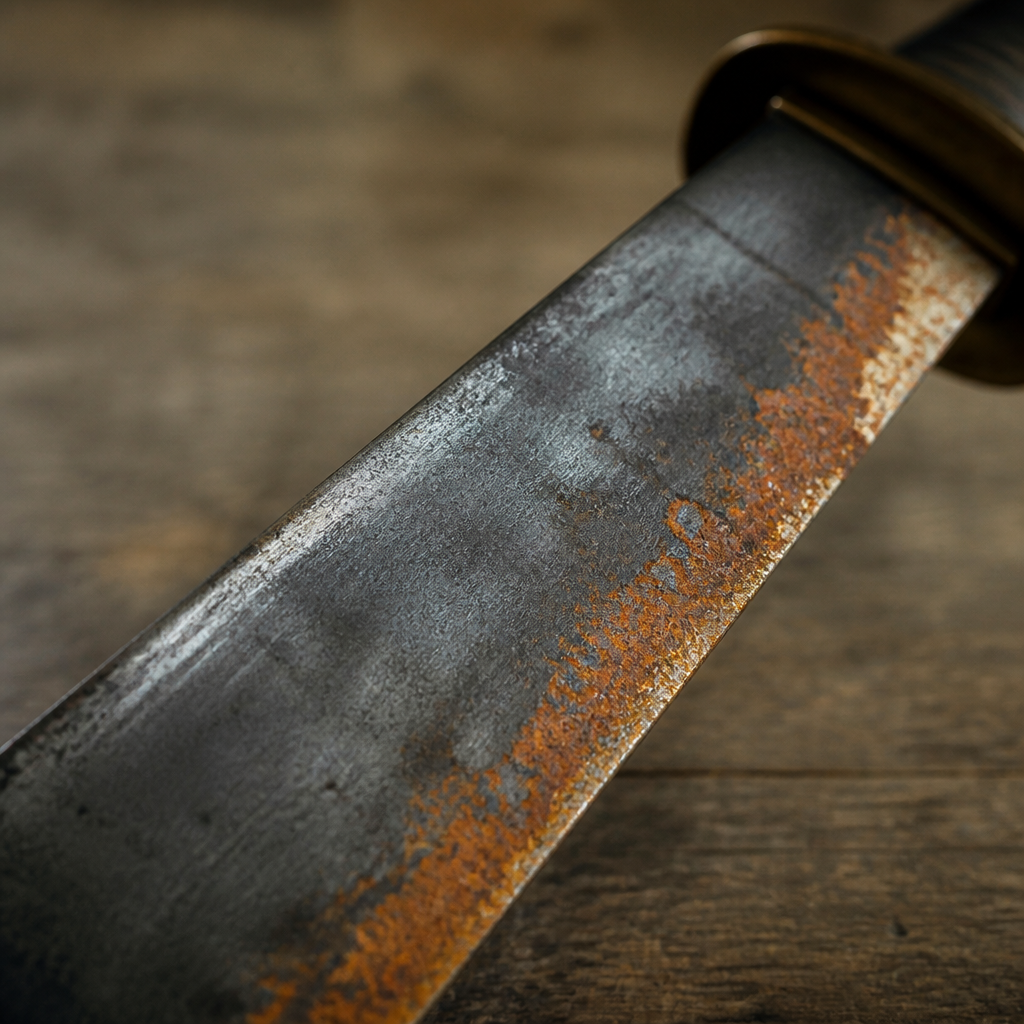
- Chlorides already inside the metal. Excavated iron carries chloride salts deep in its corrosion layers. If they are not removed by a conservator, they restart corrosion whenever humidity rises, producing the bright orange weeping pustules that collectors know and dread.
- Acid vapours. Oak and several other timbers give off acetic acid. So do some adhesives, some paints and some plastics. A blade sealed into a handsome oak case is in a small acid chamber.
- Sulphur. Wool, some felts and some rubbers release sulphur compounds, which tarnish and then attack silver inlay and copper alloy fittings.
- Its own scabbard. Leather holds moisture against the blade and carries residual tanning acids. A blade stored in its scabbard for a decade often comes out marked with the shape of the liner.
Handling
Clean nitrile gloves, or hands washed and thoroughly dried, and no hand cream. Cotton gloves are the museum tradition but they slip on polished steel, which is a real risk with a heavy blade.
Support the blade along its length with both hands when moving it, one at the ricasso and one under the flat well short of the point. Never carry a sword by the grip alone if the tang is old or the peen is loose, and never lift by the point.
Put it down on a padded, chemically inert surface, not on a bare table and not on a newspaper. Then wipe the blade with a clean dry cloth before it goes away, because you will have touched it somewhere.
Relative humidity
Humidity is the single control that does most of the work, and stability matters as much as the number: a case that swings between 30 and 60 per cent every day is worse than one that sits steadily at 50.
| Relative humidity | Effect on iron | Suitable for |
|---|---|---|
| Under 20 % | Corrosion of chloride contaminated iron effectively stops | Excavated iron, in a sealed case |
| 20 to 35 % | Very slow corrosion | Stable iron with few organic parts |
| 35 to 45 % | The usual museum compromise | Mixed collections of metal and organic material |
| 45 to 55 % | Acceptable for organics, marginal for iron | Scabbards, grips, textiles |
| Over 55 % | Active corrosion likely | Nothing you intend to keep |
| Over 70 % | Rapid corrosion, mould on organics | Nothing at all |
Silica gel conditioned to the target humidity, inside a reasonably well sealed case, is how most private collections achieve this without a plant room. It has to be reconditioned periodically, which is the step people forget.
Storage materials, good and bad
Suitable: acid free tissue, unbleached washed cotton, polyethylene and polypropylene foams, inert polyester film, powder coated or sealed metal shelving, conditioned silica gel, and microcrystalline wax on a stable, dry, non archaeological surface.
Avoid: oak and other tannin rich timbers, untreated leather, wool felt, PVC, rubber bands and rubber feet, newspaper, plain cardboard in a damp room, and sealed plastic bags with no desiccant, which trap moisture rather than excluding it.
Store blades horizontally on padded supports if you can. Hanging a heavy sword by its grip puts the whole weight on an old tang and an old peen for years at a time.
What not to do
- Do not polish, buff, wire brush, sand or blast a historical blade. Every one of these removes original surface, and with it inlays, maker's marks, hardening lines and the evidence a conservator reads.
- Do not use household rust removers or electrolysis on an object you value. They strip the corrosion and the surface underneath it together.
- Do not sharpen an antique. The edge geometry is evidence.
- Do not oil an object that has organic parts, grip wrappings, leather or horn, without advice. Oil migrates.
- Do not store a blade in its scabbard.
When to call a conservator
Any active corrosion, meaning fresh orange powder or weeping spots, is a reason to ask for professional help rather than to start work. So is any loose inlay, any flaking surface, and any object that combines metal with leather, wood, horn or textile, because those materials want different conditions and the compromise is a judgement call.
In the United Kingdom the Institute of Conservation maintains a public register of accredited conservators. Across Europe, the member associations of the European Confederation of Conservator Restorers' Organisations keep equivalent lists. Both are free to search, and an hour of advice is cheaper than an irreversible mistake.
If you are looking for well conserved reference material to compare against, the entry on public collections in Europe lists the museums whose blade displays are worth the journey.