FRG-02Steel and forging
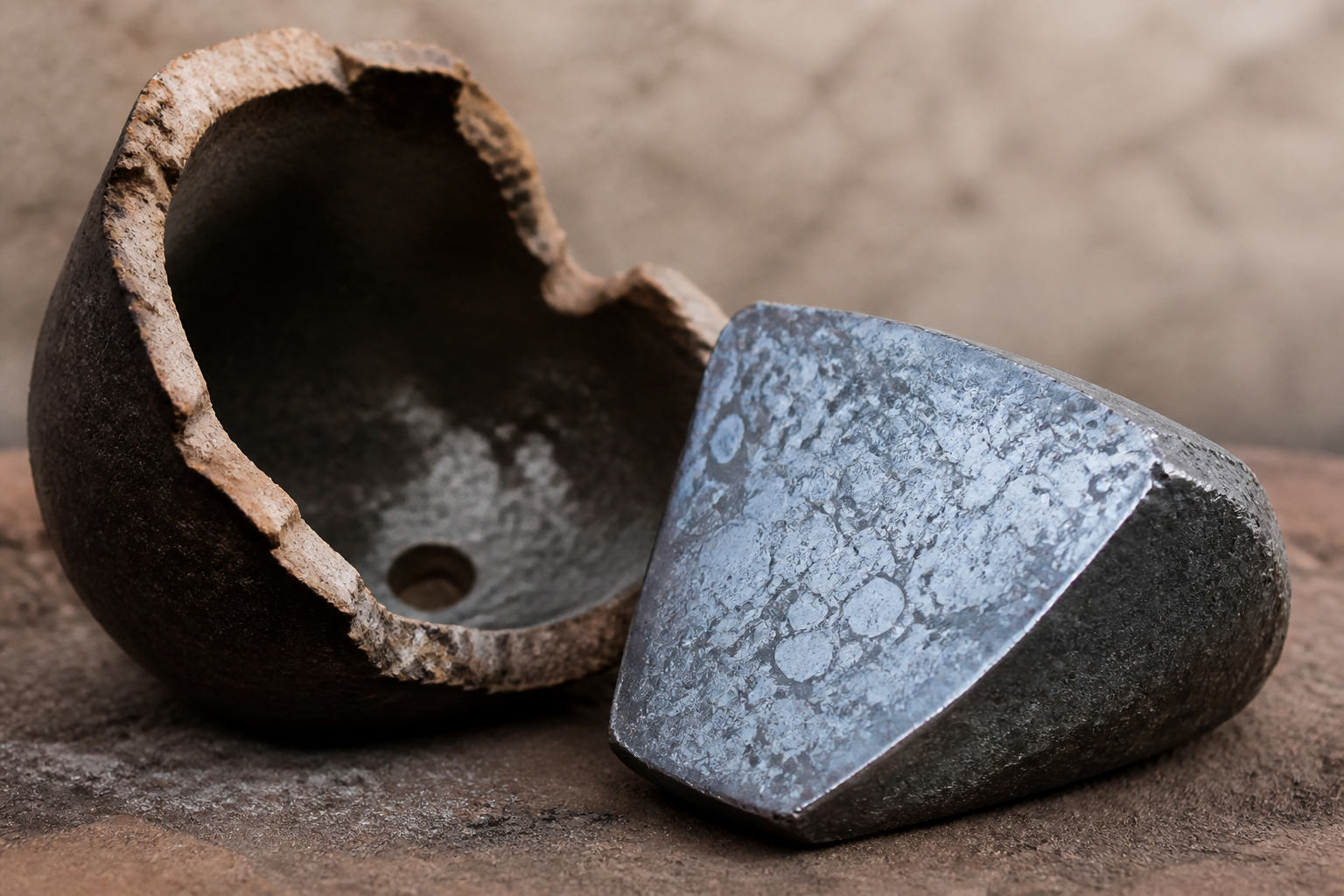
Crucible steel, wootz and the watered pattern
Melting iron in a sealed pot produces something a bloomery furnace never could: a homogeneous ingot with a carbon content high enough to form carbide bands, and with them the pattern that Europe spent two centuries failing to copy.
Published on 05/08/2026, last reviewed on 20/08/2026
Crucible steel in one paragraph
Crucible steel is made by melting iron together with a carbon source in a sealed clay pot until the metal is fully liquid. Because it melts, it comes out homogeneous, and because it is sealed with charcoal it takes up far more carbon than a bloomery furnace could ever put into iron: typically 1.0 to 2.0 per cent, against 0.8 per cent at the eutectoid and under 0.1 per cent for bloomery iron.
The ingot cools slowly inside its crucible. That slow cooling is what produces the coarse internal structure of carbide that later becomes the famous surface pattern.
Where it came from
The technique is documented in South India and Sri Lanka from the middle of the first millennium, and the ingots became a trade good. They travelled west, and the celebrated forging centres were in Persia, Central Asia and Syria rather than at the smelting sites.
This is why the European name is misleading. "Damascus steel" names a market, not a mine and not a process. The material is usually called wootz in English, from a Anglicised south Indian term recorded in the late eighteenth century.
What makes the watered pattern
The flowing light and dark pattern is not layers. It is bands of spheroidised cementite, iron carbide, formed as the high carbon ingot cooled and then strung out into rows by repeated forging and reheating. Polishing and a light acid etch reveal them.
Reproducing it defeated European metallurgists for two centuries, and the reason turned out to be chemistry rather than technique. Work published in the 1990s by J. D. Verhoeven and A. H. Pendray demonstrated that trace carbide forming elements, vanadium and molybdenum among them, present in some ores and absent from others, are what allow the carbide bands to form and persist. Clean modern steel of the same carbon content will not band.
The narrow forging window
High carbon crucible steel is difficult to work and unforgiving. Cold, it is brittle. Too hot, and it crumbles under the hammer. The usable range is narrow, commonly given as roughly 650 to 850 degrees, which is a dull red rather than the bright orange most smiths work at.
Overheating does something worse than break the bar: it dissolves the carbides back into solution, and the pattern is then gone permanently, whatever is done afterwards. A blade that has been overheated once cannot be brought back.
Europe's own route to steel
Europe reached homogeneous steel by a different road, and the milestones are well dated.
- Cementation, or blister steel. From the sixteenth and seventeenth centuries, bars of wrought iron were packed in charcoal inside a sealed chest and held at heat for several days. Carbon diffused inward from the surface, leaving bars that were harder outside than inside and blistered on the skin.
- Shear steel. Blister bars cut, stacked, welded and drawn out, repeatedly, to even out the carbon. Better, still not uniform.
- Huntsman's crucible process. From about 1740 in Sheffield, Benjamin Huntsman remelted blister steel in closed clay crucibles, producing genuinely homogeneous cast steel and, with it, the modern edge tool industry.
- Bulk steel. The Bessemer converter of 1856 and the open hearth furnace of the 1860s turned steel from a craft product into an industrial one.
What modern blades are made of
For anyone comparing a reproduction with a historical piece, this is the useful table. Carbon content is what decides whether a blade can be hardened at all, which is the subject of hardening and tempering.
| Material | Carbon | Period | Behaviour |
|---|---|---|---|
| Bloomery iron | under 0.1 % | Antiquity to c. 1400 | Will not harden by quenching |
| Phosphoric iron | under 0.1 % C, up to 1 % P | Antiquity to c. 1000 | Hard to weld, etches pale |
| Bloomery steel | 0.3 to 0.8 % | Antiquity to c. 1600 | Hardens, but unevenly |
| Blister steel | 0.5 to 1.2 % at the surface | 16th to 19th century | Hard skin over a softer core |
| Crucible steel, wootz | 1.0 to 2.0 % | Mid first millennium onwards | Homogeneous, carbide banding |
| Huntsman cast steel | 0.6 to 1.2 % | From c. 1740 | Homogeneous and repeatable |
| Modern 1075 and 1080 | 0.70 to 0.80 % | Modern | Plain carbon, the usual reproduction steel |
| Modern 5160 | about 0.60 %, with chromium | Modern | Spring steel, very tough |
| Modern 9260 and EN45 | 0.55 to 0.64 %, with silicon | Modern | Spring steel, high elastic limit |
A reproduction in 1075 or 5160, properly heat treated, will outperform almost any medieval blade in consistency. It will not look like one, because the surface of a modern rolled bar has none of the welding lines and slag stringers that a pattern welded or bloomery blade carries as a matter of course.