TYP-01Typology
The Oakeshott typology, type by type
Ewart Oakeshott sorted medieval European swords by the shape of the blade rather than by the country or the century they came from. His types run from X to XXII, and they are still the labels you meet on museum cards.
Published on 08/07/2026, last reviewed on 20/08/2026
What the typology sets out to do
Ewart Oakeshott (1916 to 2002) was a British writer and collector who spent decades handling swords in private hands, in salerooms and in museum stores. He published his classification in The Archaeology of Weapons (1960), developed it in The Sword in the Age of Chivalry (1964), and then set out the evidence piece by piece in Records of the Medieval Sword (1991).
The scheme covers Europe from roughly 1050 to 1550. It begins where the Viking age hilt typologies stop and ends when the civilian thrusting sword takes over in town.
An Oakeshott type describes the blade, not the whole sword. It is a statement about geometry: how fast the edges converge, what the cross section looks like, and how far the fuller runs. Two swords of the same type can carry completely different hilts, because hilts were repaired and replaced during a working life while the blade stayed.
How a blade is read
Three observations do most of the work, and all three need the sword in the hand rather than a photograph of its flat side.
- Profile taper. How quickly the edges converge from shoulder to point. Little taper means a blade built to cut; a strong taper means a point built to be driven into a gap.
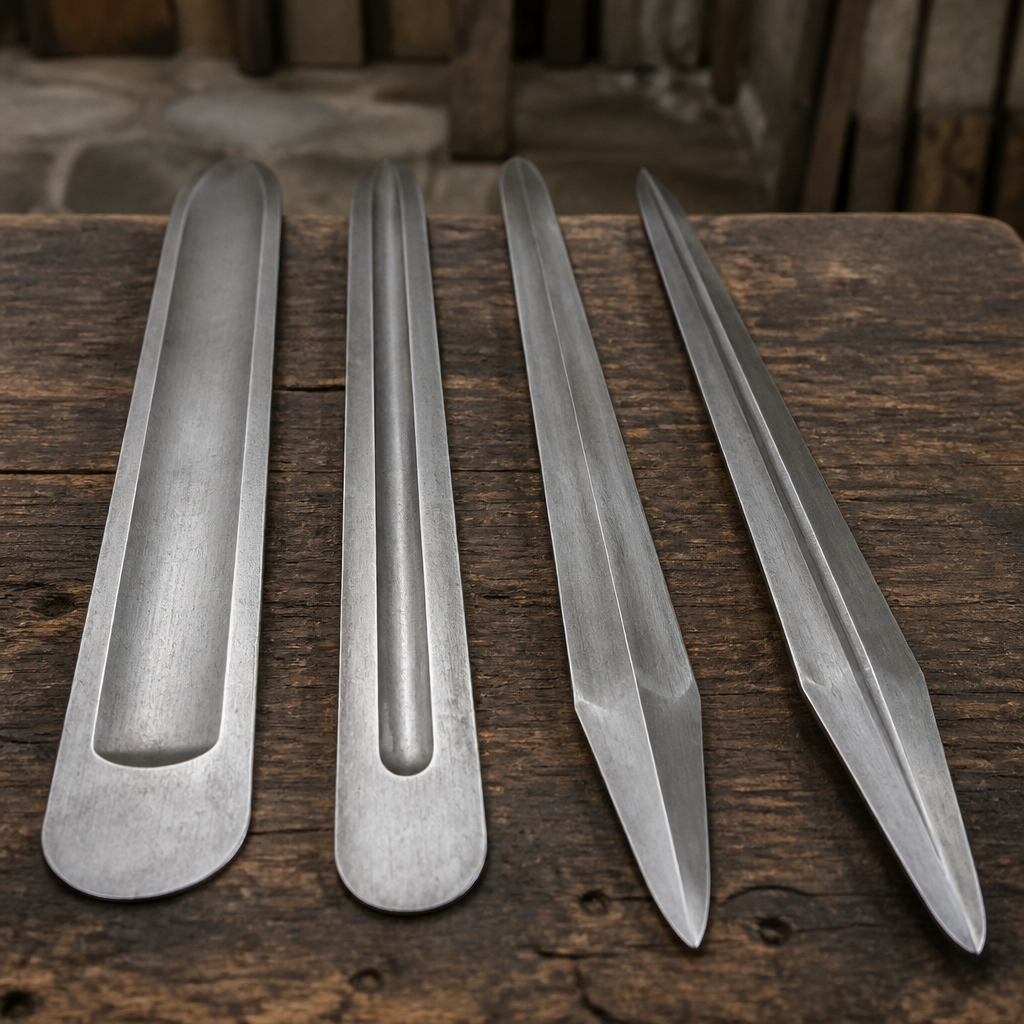
- Cross section. A lenticular section, shaped like a flattened lens, spreads mass behind the edge and suits cutting. A diamond or hexagonal section stiffens the blade against buckling and suits thrusting. Hollow ground flats remove weight without losing stiffness.
- Fuller. A groove forged or ground along the blade. Broad, shallow and long on early cutting blades; short and narrow on transitional blades; absent on stiff thrusting blades, where a raised midrib does the same job.
Distal taper is the fourth measurement and the one most often forgotten: the blade also thins from hilt to point, commonly from 6 to 8 mm at the shoulder down to about 2 mm near the tip. Two blades with identical outlines can feel completely different because of it.
One correction while we are here. The fuller is not a blood groove and has nothing to do with suction. It lightens and stiffens the blade in the same way the web of a steel beam does, and it is described in the glossary of blade parts along with the ricasso and the distal taper.
The types in order
The table below is a working summary. It is meant for the moment when you are standing in front of a case and want to know roughly where a blade sits, not as a substitute for the measured records.
| Type | Usual dates | Blade | Fuller | Built for |
|---|---|---|---|---|
| X | 1000 to 1150 | Broad, flat, edges nearly parallel, rounded point | Broad and shallow, almost full length | Cutting |
| XI | 1100 to 1175 | Longer and narrower, slight taper | Narrow, long | Cutting from horseback |
| XII | 1150 to 1350 | Even taper to an acute point | About two thirds of the blade | Cut and thrust |
| XIII | 1240 to 1350 | Broad, parallel edges, spatulate point, long grip | Broad, about half the blade | Cutting at the full extension of the arm |
| XIV | 1275 to 1340 | Short, wide at the hilt, sharp taper | Broad, upper half only | Cutting, with a usable point |
| XV | 1290 to 1500 | Straight taper, flat diamond section | None | Thrusting into gaps in plate |
| XVI | 1300 to 1350 | Fullered upper half, stiff diamond lower half | Short, upper part | Cut and thrust in one blade |
| XVII | 1360 to 1420 | Long, heavy, thick hexagonal section | None or very short | Two hands against reinforced armour |
| XVIII | 1410 to 1510 | Broad at the hilt, strong taper, diamond section | Short or none | Cut and thrust, many subtypes |
| XIX | 1350 to 1500 | Flat, near parallel edges, pronounced ricasso | Narrow, upper part | Cut and thrust, often complex hilt |
| XX | 1300 to 1450 | Large two handed blade, wide at the hilt | One long central, two short flanking | Great sword |
| XXI | 1400 to 1500 | Wide and short, strong taper (cinquedea) | Several short fullers | Civilian wear, mainly Italy |
| XXII | 1400 to 1500 | Wide, flattened, near parallel edges | Two short narrow fullers near the hilt | Civilian and ceremonial |
Read down the table and the story is visible: broad parallel cutting blades at the top, blades that keep a cutting edge but gain a point in the middle, and stiff acute thrusting blades at the bottom, arriving exactly when plate armour became common.
Pommels and crosses are classified separately
Oakeshott gave pommels letters, from A to Z with variants, and cross styles numbers from 1 to 12. A full description therefore reads like Type XIV, pommel K, cross 6: blade, then pommel, then cross.
The common pommel shapes have names that are worth knowing because catalogues use them: the brazil nut of the eleventh century, the disc and the wheel of the thirteenth and fourteenth, the faceted scent stopper of the fifteenth, and the pear or fig shapes that run alongside them.
Keeping the three parts separate is not pedantry. A fourteenth century blade can sit in a fifteenth century hilt, and a museum label that gives a single date is usually dating the blade.
Four mistakes people make with type names
- Treating the types as a timeline. They overlap heavily. Type XII and type XIII were in use at the same time, and type XV runs for two centuries.
- Reading a type as a nationality. Blades were traded across Europe and hilted locally, so the blade and the hilt can point to different places.
- Calling every large two handed blade a type XX. Type XX has a specific fuller arrangement, one long central fuller flanked by two short ones.
- Deciding a type from a photograph. Cross section and distal taper are invisible from the flat, and they are half the classification.
How to check a type without guessing
Measure and write down six things: blade length from the shoulder, width at the shoulder, width 10 cm from the point, thickness at the shoulder, thickness 10 cm from the point, and where the fuller ends. With those six figures the candidate types usually reduce to two, and the cross section settles it.
Then compare. Records of the Medieval Sword lists hundreds of measured examples by type, and several museums publish object records with measurements online, which is the fastest way to calibrate your eye. Our entry on where to see European swords lists the collections whose catalogues carry that level of detail.
If the sword you are looking at is earlier than about 1050, this scheme is the wrong tool: use the Viking age hilt typologies, which classify by pommel and guard instead of by blade.